Review of Never Have I Ever Girls Edition
I t's the first day of sophomore year, and xv-yr-sometime Devi (Maitreyi Ramakrishnan) kneels in front end of the Hindu shrine (and her blest geometry textbook) in her home in Sherman Oaks, California. She has some requests, the profound goals of many loftier school girls: be cool, get hot, snag a boy. Or, every bit Devi spins at the start of this uneven just endearing 10-part teen entry from executive producer Mindy Kaling, she wishes her arms no longer "looked like the floor of a frickin' hairdresser shop". Most importantly, she craves a young man, but "not some nerd from 1 of my AP classes," she says with Booksmart-fashion conviction. Said boy "can be dumb – I don't care. I merely desire him to exist a stone-cold hottie who could rock me all night long."
Devi is, needless to say, a virgin, and as well an intelligent firebrand with a seemingly effortless command of power-points, witty barbs and topical-enough popular culture references ("Yes, merely he has a hot face. You lot'll be like Zayn and Gigi," she tells her friend as a fellow sales pitch). She's besides a principal deflector, reeling, with a John McEnroe-style brusk fuse, from a massive loss. (McEnroe, for no reason seemingly beyond the fact they could get him, narrates the serial.) "Equally you lot know," she one-half-prays, "concluding year sucked for a number of reasons." As abruptly revealed in what seems similar a first-episode fleck but is not, her beloved father – a sunny, unbridled presence in sepia flashbacks and dream sequences, and Devi's only true best friend – died of a eye attack at her orchestra concert the year prior. The shock paralyzed her for three months (teenagers: non forgiving of the concept "psychosomatic"), forcing her to utilise a wheelchair. Simply the sight of her beat, swim-squad boy and said stone-cold hottie Paxton Hall-Yoshida (Darren Barnet) – a layered mystery or stock jock character, depending on the scene – and the hope of a "rebrand" in sophomore year, zaps Devi back on her feet.
The showtime few episodes are clunky, as Devi, in denial-steeled striver mode, directs or antagonizes characters seemingly identified by ane joke: her cousin Kamala (Richa Moorjani), the beautiful "good Indian" doctorate student at CalTech, wide-eyed with America and preparing for arranged marriage; insult-throwing academic rival and rich child Ben (Jaren Lewison). Checklist in hand, she directs her ii best friends, Eleanor (Ramona Immature) and Fabiola (Lee Rodriguez), into cool-side by side boyfriends and a 10-step popularity plan. The show, which shares an aesthetic (and glittery, Spotify-gear up pop soundtrack) with Netflix's teen staple To All The Boys I've Loved Before, takes a swift and more often than not tacit approach to diversity in its young bandage; classmates have designated the trio of Devi, southward-east Asian Eleanor and Afro-Latina Fabiola as "the UN", and the makeup of Sherman Oaks Loftier is refreshingly and conspicuously not merely white, cis, able-bodied. But for virtually other than Devi, this goes unmentioned; the philosophy for the characters and, information technology appears, the show, is to attain the long-sought platonic of being "just a normal teenager" and expanding who gets to claim such a distinction.
The main force for this is Devi, who recoils at the stereotypically strict immigrant parenting of her mother (an excellent Poorna Jagannathan), dismisses Indian culture and dreams of running away. In the flavour'south commencement half, she seesaws from securely insecure to fearless – the plot launches equally she writes a checklist for her best friends' "rebrand" and, in a viscerally cringe-y scene, directly approaches Paxton, introduces herself, and asks if he would have sex activity with her (and, when this works, gushes "We'll circumvolve back near information technology!").
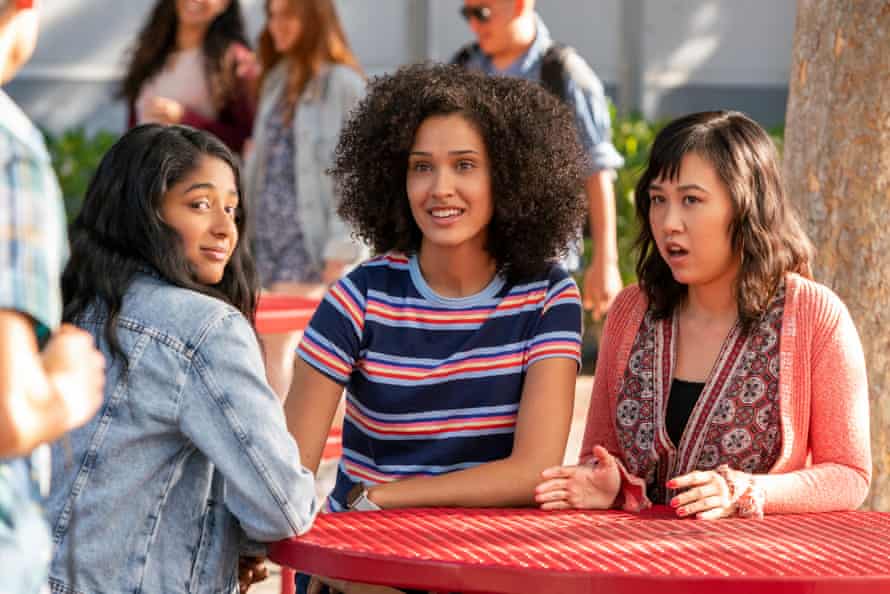
Information technology is refreshing, and exciting, to encounter someone like Devi given the Fleabag treatment: infinite to avoid grief by misbehaving, an exploration of the bitter pills of growing up with a darkly comic touch on. But in its early episodes Never Have I Always applies the evidence of Devi's assholery – soliciting of Paxton, lying repeatedly to her friends, never listening – too thick. It'southward welcome to encounter an insolent Indian American star, which Never Have I Ever shares with Kaling predecessor The Mindy Project, cocky-sabotage with artlessness. But like the former show, information technology can also be grating. It's not until the prove's subsequently episodes, when information technology raises the emotional stakes for anybody – depicting Ben'south lonely habitation life, contextualizing Fabiola and Eleanor'due south one-notes as "robot nerd" and "drama geek", playing with the eternally gutting story that is getting stood up – that the jokes start to pack a punch.
Ramakrishnan, a newcomer discovered through a global casting search, shows her inexperience here and there, but shines in the series' more emotionally demanding scenes; her rawness in the final episode moved me to tears. Which is evidence that, though not a perfect ride and probable to exist overhyped out of starvation mode for any teen comedy resembling the bodily multifariousness, horniness, and profanity of being a teenage daughter, Never Have I E'er gets at that place, somewhen. The series' back half settles into a storyline balancing emotional depth with outbursts, and what emerges is a moving and original portrait of a teenage girl grappling with grief. It's a bummer that it couldn't take arrived at this version faster but, as Devi and the prove learn, there's ultimately satisfaction in ditching the attending grabs and finding your pace.
-
Never Have I Ever is at present bachelor on Netfllix
Source: https://www.theguardian.com/media/2020/apr/27/never-have-i-ever-netflix-mindy-kaling
0 Response to "Review of Never Have I Ever Girls Edition"
Postar um comentário